Twitter
    Follow me on Twitter

The only real energy solution

Dual-posted on Facebook: http://www.facebook.com/note.php?note_id=440932770750

I can't talk about energy nowadays without mentioning the recent oil spill. Well, I know what kinds of stuff people are saying all over the internet and frankly, I don't give a fuck. This incident is the perfect example (just like Hurricane Katrina) that no one in big business or the government (together they make FASCISM, not CAPITALISM) really cares about anything except the bottom line profits. I am NOT going to speculate anything about peak oil, carbon taxes, or any of that nonsense. What I WILL do is talk about various methods of power generation and which ones will work the best in the long run.

Again, I refuse to speculate on anything involving the recent oil spill on the Gulf of Mexico. It's a mixture of bad business practices with bad political leadership. Yes, the two sides are in bed with each other, but what isn't nowadays? Stop looking deep into it and finding things that aren't really there. That's all this situation is.

Oh, and it's not an excuse to start imposing carbon taxes (which BP will BENEFIT from because they're involved in the carbon trade). Don't jump in favor of "alternative" energy because... well... you'll see.


Here are some common energy sources and the basic ideas within them.

1. Coal
It's available as needed, but the environmental costs make it prohibitive in many cases. But it's a catch-22 because there is so much coal available, and shutting down the economy is destructive. Clean coal technology can minimize pollution. Unfortunately, almost all of clean coal technology is devoted ONLY to carbon capture while doing nothing to reduce the real, legitimate threats to the environment.
2. Oil
Oil is cleaner and more effective than coal, but the environmental problems are probably equal due to accidents that can happen. Peak oil is mostly bullshit because there is still a lot more oil in certain areas of the world where you can't dig it out. For example, the California coast. The best way to get this (which is safer to reach than the oil in the Gulf of Mexico) is by lifting the bans on offshore drilling, which you can't do or else Greenpeace will dump all of the oil on the west coast to prove their point. There is SOME clean oil technology just like clean coal, but again, it's being used to capture carbon and not really clean up the smog.

3. Gas
Gas is cleaner than oil, but is much more expensive. The amount of environmental damage is also, comparatively, very low. Remember the combustion reactions in Chemistry classes? Yeah. And gas is about as clean as you can get from a traditional fuel source. The biggest worries are that you need a pipeline to constantly support the plant, and even the slightest accident could cause an explosion. You can also get this gas from both farms and landfills, which is a way of recycling energy and making things more efficient.

4. Hydroelectric
-Really hard to build
-Doesn't generate much power
-Disrupts too many ecosystems
-Not enough rivers to build on
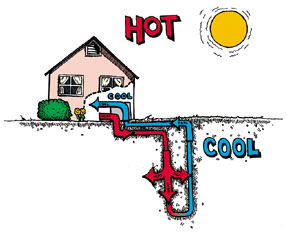
5. Geothermal
It's overall a really good power source, but how many people live in places like Iceland? Almost none. The only threat is a volcanic eruption, and that alone can stop a lot of people from living anywhere near these power plants.

6. Biofuel
This is the biggest bullshit I ever heard of. If you spend a lot of time in a supermarket, you've probably noticed that food prices have more than doubled in the past few years. Why is that? The conventional idea is that global warming is causing droughts, which is reducing crop yields. That's why they want us to replace the edible crops on farms with more biofuels. But wait! Didn't food prices go up in the first place because of biofuels? And now they want the farmers to replace the food they grow with MORE biofuels? Won't that raise the food prices even more? Won't that make people in third world countries starve to death?

The environmental laws say that biofuels are carbon-neutral. Why? Because it's the law, that's why! Well, these biofuels are usually horribly inefficient and they do more damage than they benefit. A farmer will grow only ONE crop (corn or soy) all the time instead of the crop rotation and mixed farming they learned about, because farming regulations are prohibitive and there's a lot of money to be made selling biofuels. This will ruin the soil in the farmland and all surrounding areas. Then the biofuel will have to be processed, which will probably use energy from coal or oil-powered engines or power plants. Then that has to be transported to a new location, in an oil-powered truck. Then it will be stored somewhere where the storage facility is maintained by fossil fuel-powered power plants. Then it will be burned at an efficiency rate LOWER than fossil fuels! In every step of the way from growing crops to using the fuel, people will need to be heavily subsidized by the government because otherwise, it would take more energy to grow, process, and ship the fuel than you would receive from actually using it. Carbon-neutral my ass.

"But if we don't keep up this nonsense, too many people will lose their job!" ~ John Maynard Keynes

7. Solar
The technology is behind many other power sources by several decades. Also, it's really hard to get enough solar power unless you live in a tropical arid place. It's also overly subsidized so it uses up more energy than it gives you back.

8. Wind
There are two kinds of places where wind power is a viable option. One is TORNADO ALLEY. The other is coastal regions. You can't put them in coastal areas because Greenpeace will destroy them. Many people say that the wind mills pose a significant threat to migratory birds, but the ones who get killed are the weaker ones who die on migration routes anyway. And most birds will never migrate at a height of 50 metres, which is a typical height for wind mills.


9. Nuclear fission
Nuclear power is overall the cleanest, safest, and most effective electricity generation system ever designed. There have only been two disasters. Chernobyl was a horrible failure of the USSR and that thing was built sub-standard by every definition. Three Mile Island wasn't as bad as the media (AND GREENPEACE) made it out to be; the farmers near the plant got the equivalent radiation of a chest X-ray. It was handled really well, and is the kind of disaster that only happens once in a lifetime. The containers that nuclear waste is stored in are indestructible, and science is progressing so rapidly that people will find ways of using the waste in only a few decades. The terrorist threat is more hype than reality, because the real threat is statistically negligible compared to everything else that goes on. But if you really need a new place to dump the nuclear waste, I recommend feeding it to Greenpeace members.

10. Wave
Power from waves of moving water. It sounds like a great idea, but it hasn't been extensively studied. No one wants to attempt it because the initial costs are astronomical and no one knows what the returns will be. We're better off only studying it for a while.


Okay, so fossil fuels are destroying the environment, most of the "clean" energy sources cost more than they benefit, and Greenpeace is making everything worse. What do we do? Well, we need to get rid of Greenpeace, first of all. Then what?
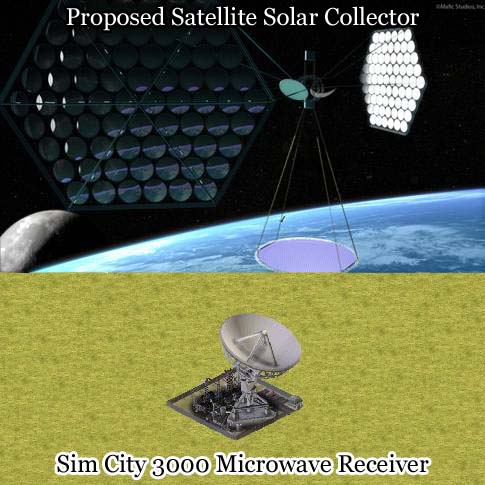

Have you ever played SimCity? Remember the Microwave power plants? Believe it or not, we actually have that technology. I'm not sure why no one really talks about it, but several countries (including the United States) have space programs capable of capturing massive amounts of sunlight and beaming it back to giant Microwave satellites on Earth. You can read about it here.
[ http://en.wikipedia.org/wiki/Space-based_solar_power ]

If there's anything that will get us out of a horrible depression quickly, it's microwave power. It's also the one solution that will completely replace petroleum for electricity generation. And the power source is unlimited; you can easily send more orbiters out to space to beam to more parabolic dishes on Earth. Electric cars will go on the mass market within the next 20 years or so, and with good batteries, that eliminates the need for oil (or hybrid technology, which just doesn't work).

The technology is still in its infancy, but just like SimCity, it will be available by the year 2030. Even the Peak Oil people think we will run out of oil by then.


Before oil, people were using coal and horses. Well, the horses were pooping all over city streets and it became a serious health and environmental hazard. In a way, the automobile replacing the horse and buggy cleaned up the environment. Now, space-based solar power replacing fossil fuels will help to accomplish the same thing.

This is just another example of an impossible problem being solved by humans with relative ease. I don't pay attention to all the nasty things that people say about humanity. There are good things and bad things in all of us, and I don't think we appreciate the good things enough.


Your thoughts?

The Progress of Ideas

Some people will tell you that nothing original has come out of anything in the last ________ (unit of time), while others will continuously marvel at human innovations for all of eternity. Well, I'm going to settle this once and for all.

First, I'd like to ask you one question. What does World of Warcraft have to do with Christianity?

Are you stumped? You should be.

Let's start with World of Warcraft. For the record, I refuse to play this game because I've heard how addicting it is. Anyway, one of the races you can play with in this game is the Orcs. It's a very original game, right? Well, no. There have been countless MMORPG's before WoW, and there were countless video games before MMORPG's. Before that, there was Dungeons and Dragons, and before that, Chess. The Orcs are original, right? Wrong! They were created by Tolkien.

So now we're back to Tolkien and his Middle Earth collection. It's very original, is it not? Let's just take the Dwarves for example. They're from Norse mythology. And then there's the one ring, which is based off of the opera, Der Ring des Nibelungen, composed by none other than Richard Wagner. And that's based off of the Nibelungenlied, which is an old German epic poem.

The Nibelungenlied is a story about the German migration in the 400's AD, where the Germans were being massacred by the Burgundians and the Huns, which happened in the interim period between when the Roman Empire had collapsed and the Christian Roman Empire had emerged.

So, in a way, Christianity was the trigger that made World of Warcraft possible.

I could give you countless other examples, but I think you get the idea.

Did I just prove that there are no original ideas? Well, yes and no. World of Warcraft is similar to Middle Earth, but it's not the same. Middle earth is similar to Norse mythology, but it's not the same.

The truth is, every new idea is based on some other existing idea. That's just the way things are. However, at the same time, every new idea is unique, despite being based on everybody else's ideas. Why? Because every human being on this planet who thinks of such an idea is a completely unique individual in every way.

THAT's how different people can have ideas all based on the same roots and still be real innovators. After all, it's through such an exchange of ideas that human progress is made.

The Prophecy of the Condor and the Eagle

From Confessions of an Economic Hit Man (page 209) by John Perkins:

"Nearly every culture I know prophesies that in the late 1990's we entered a period of remarkable transition. At monasteries in the Himalayas, ceremonial sites in Indonesia, and indigenous reservations in North America, from the depths of the Amazon to the peaks of the Andes, and into the ancient Mayan cities of Central America, I have heard that ours is a special moment in human history, and that each of us was born at this time because we have a mission to accomplish.

The titles and the words of the prophecies differ slightly. They tell variously of a New Age, the Third Millennium, the Age of Aquarius, the Beginning of the Fifth Sun, or the end of old calendars and the commencement of new ones. Despite the varying terminologies, however, they have a great deal in common, and “The Prophecy of the Condor and Eagle” is typical. It states that back in the mists of history, human societies divided and took different paths: that of the condor (representing the heart, intuitive and mystical) and that of the eagle (representing the brain, rational and material). In the 1490's, the prophesy said, the two paths would converge and the eagle would drive the condor to the verge of extinction. Then, five hundred years later, in the 1990's a new epoch would begin, one in which the condor and the eagle will have the opportunity to reunite ad fly together in the same sky, along the same path. If the condor and eagle accept this opportunity, they will create a most remarkable offspring, unlike any seen before.

“The Prophecy of the Condor and Eagle” can be taken at many levels — the standard interpretation is that it foretells the sharing of indigenous knowledge with the technologies of science, the balancing of yin and yang, and the bridging of northern and southern cultures. However, most powerful is the message it offers about consciousness; it says the we have entered a time when we can benefit from the many diverse was of seeing ourselves and the world, and that we can use these as a springboard to higher levels of awareness. As human beings we can truly wake up and evolve into a more conscious species."

I do not believe there is intelligent direction of the universe or that we were “born at this time because we have a mission to accomplish.” But there are patterns in the evolution of culture that intuitive people can recognize. When similar prophetic visions occur independently in many cultures, they should be taken seriously. However, specific interpretations of these visions should always be treated with a healthy dose of skepticism.

Here is my take on this prophecy. Western Culture, since the middle ages, has been increasingly dominated by intellect at the expense of other dimensions of the human psyche. This one sided development of reason created modern science and technology through which Western culture has dominated the planet. Reason is a very powerful but also very limited tool. Inevitably it seeks over simplistic models in domains that are too complex for a rational model.

In large part, my thinking follows Carl Jung's Psychological Types. Jung saw the human psyche organized around two pairs of opposing functions: thinking versus feeling and intuition versus sensation. The first pair represent rational functions. Thinking organizes material from an objective standpoint as an engineer might. Feeling organizes material from the standpoint of what is important to ones well being as a mother protecting her children might. Since these represent different rational ways of organizing the same material it is difficult to develop both of these functions.

The irrational opposites are similarly difficult to develop together. They are both pattern recognition processes. Sensation looks for patterns in what is present here and now. Intuition looks for the patterns that explain what lead to the current state of affairs and how the situation may evolve over time. Sensation types cannot see the forest for the trees. Intuitive types are well aware of the forest as they crash into the tree in front of them.

At this stage in history the natural next step is the development of intuition. Developing feeling, the opposite function to dominant thinking, is too difficult. Intuition and not sensation has the potential to offset the over simplistic views that is a fundamental weakness of intellect.

Of course both intuition and intellect have been essential to the development of science and technology. However intellect has remained in the driving role. Academia is focused on developing intellect, Intuition is seen as an almost magical force that just happens without systematic development. Ancient systems of developing intuition like astrology, tarot, and the I Ching remain steeped and superstition and no modern replacements have evolved.

Intellect's dominance cannot be overthrown externally. Instead it bears the seeds of its own waning influence. This is starting to happen at many levels. As intellect solves more of the problems that it is capable of dealing with, it expands the scope and importance of problems that are beyond it. For example the enormous improvements of productivity that technology has created are beginning to be a problem. Instead of leading to better lives for everyone, they are concentrating wealth into ever fewer hands, while earning a decent living is becoming more difficult for the vast majority. Simplistic laissez-faire capitalism exasperates the problem. A far more subtle and complex understanding is required. This can only be done through open minded experimentation using both intellect and intuition to design and interpret the experiments.

Intellect seeks the solution, the correct answer the true path. The ultimate achievement of intellect is mathematics. This is a pure product of reason unsullied by the ambiguity and complexity of the real world. Yet is in precisely this purest of intellectual products that the limitations of reason become most apparent. It has been proven with mathematical certainty that there can be no single path approach to discovering all mathematical truth. This can only be accomplished with a divergent process that, over time, follows an ever increasing number of paths. This result is known as Gödel's Incompleteness Theorem.

I see this prophecy as fortelling the rise of intuition and the beginning of a reconnection with ancient wisdom that does not fit into a narrow intellectual framework. But this must not and cannot be an abandonment or a renunciation of the achievements of intellect. It must be a union of the two that creates something different than and beyond what exists today.

I have spent a good part of my life thinking about these issues. One result is the book: What is and what will be.

Paul Budnik

+++++++++++++++++++++++++++++++++++

 That being said, I'm a big fan of racial integration.

  I'm sure many of you are either multiracial or have been involved in a multiracial relationship, so many of you will be able to relate.

The year 2000 was the first time that the U.S. Census started keeping track of people who are multiracial. It turned out that 7.8 million people were counted, and 41% were under 18.

Just look all around you. Mixed people are everywhere. Even though it is happening at a faster rate in the United States than other countries with substantial immigrant populations, this trend is spreading like wildfire.

It's because of the global world that we live in. Race doesn't matter so much anymore. After a few generations, race will cease to exist in most countries.

I have friends of every race, and I'm a huge fan of integration. Every race/ethnicity/whatever has its own strengths and weaknesses. The mixed kids get the best of both parents. They're also way less likely to get any genetic disorders. Because genetic disorders tend to be native to one group or another, the genes of mixed people will be so diluted that finding two identical alleles on both chromosomes will be an extremely rare occurrence.

What I don't understand is why so many people are opposed to this kind of thing. Yeah, the kids won't really be tied to one culture or another. In this new day and age, who IS anymore? In the new global culture, even the economic slave third world countries are contributing their share.

For my part, I'm not starting a family with someone else who's from the same part of the world as I am. And no, I obviously don't care what my parents have to say about it. I'm not very Bengali anyway. I never go to Bengali Cultural Club, I don't speak Bengali outside of the house, and I have almost no Bengali friends.

I also want to have one or two kids of my own and adopt several more from all over the world. Imagine how that would look in a family photo...

Eh... I can dream, can't I?

How to Refute Global Warming: Intro

Unless you've been living in a bubble for the past few weeks, you've heard the whole Climategate story. I won't bother telling you about it because you can get plenty of that from other videos.

What? You're in a bubble? Fine, just watch this:

It doesn't make any sense to you? Oh well.

So the question on everybody's mind right now is, does this scandal prove once and for all, beyond a shadow of a doubt, that man-made global warming is fiction?

Of course not. There is no way of knowing from a bunch of politically motivated emails whether or not the climate really is changing the way we think it is. Instead, the only way to really understand the climate crisis and what's causing it is to look at legitimate science for the answer. For the next few months, I will be showing you just that: scientific evidence on the whole global warming deal.

If you have questions, you're certainly welcome to submit them, and I will try to answer them as much as possible. Just in case there are any serious doubts about what I say, with each video I'm going to include a link to my blog, where you can get a full transcript with all of my sources cited.

So... for now, just stay tuned and subscribe to my YouTube videos. I will upload my first video on the issue in a few days, and I hope to upload at least one video a week after that, for as long as it takes to convince you of the truth.

http://www.youtube.com/InMooseWeTrust